
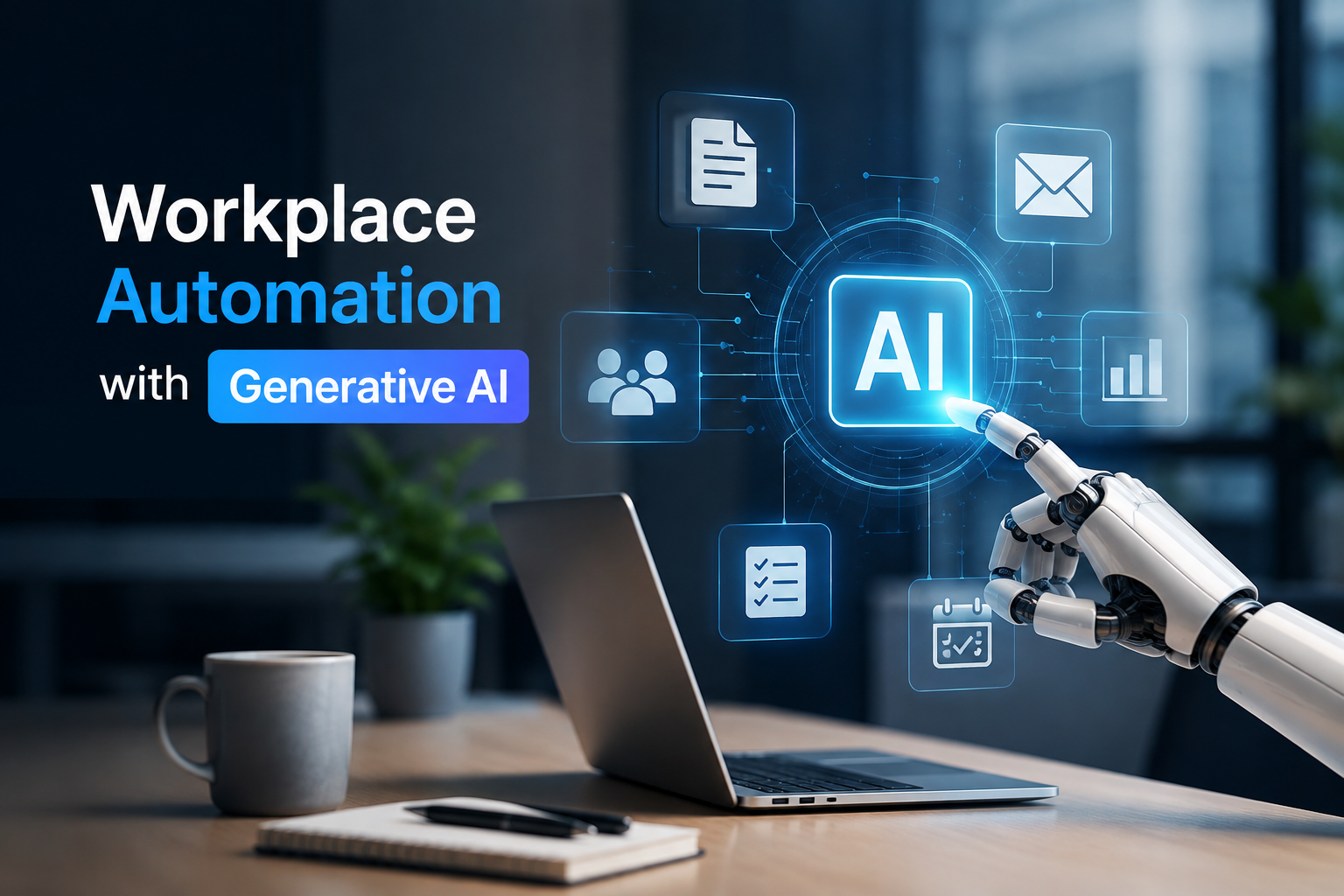
Workplace Automation With Generative AI

Workplace Automation with Generative AI helps businesses automate repetitive tasks, streamline workflows, improve productivity, and use AI to make faster, smarter decisions. The Workplace Automation With Generative AI program is designed to help professionals, business teams, and organizations understand and implement Generative AI to automate everyday workplace tasks, streamline business processes, and improve productivity. The course focuses on practical applications of AI across communication, documentation, data management, research, customer support, reporting, project management, and other common business functions. Learners will discover how Generative AI can reduce repetitive manual work, accelerate decision-making, improve the quality of business outputs, and create more efficient workflows. Rather than focusing only on AI theory, the program emphasizes practical workplace use cases and teaches participants how to identify automation opportunities, design AI-powered workflows, select appropriate tools, and integrate AI into existing business processes. Through hands-on exercises and real-world scenarios, learners will gain experience creating AI-assisted workflows for emails, reports, presentations, meeting summaries, research, content creation, data analysis, task management, and business operations. The program also addresses responsible AI adoption, privacy, security, accuracy, human oversight, and change management, ensuring that automation is implemented effectively and responsibly. By the end of the program, learners will be able to confidently use Generative AI to transform repetitive workplace activities into smarter, faster, and more scalable processes.

About

Learn how Generative AI can transform workplace processes by automating repetitive tasks, creating content, analyzing information, and supporting smarter decision-making.

Workplace Automation With Generative AI is a practical, career-oriented program created for professionals who want to understand how Generative AI can be applied to everyday business operations. As organizations increasingly adopt AI-powered tools, employees are expected to work more efficiently, automate repetitive activities, and use intelligent technologies to improve productivity.

This program provides a structured understanding of how AI can be incorporated into different workplace functions without requiring advanced programming knowledge. Learners will explore AI-powered productivity tools, prompt engineering, workflow automation, document processing, communication automation, research assistance, data analysis, and AI-enabled decision support.

The course also teaches learners how to think beyond individual AI prompts and create complete AI-powered workflows. Participants will learn to connect multiple steps in a process, establish reusable instructions, automate repetitive actions, validate AI-generated results, and maintain appropriate human oversight.

Special attention is given to identifying the right tasks for automation. Learners will understand which workplace activities can be safely automated, which require human review, and how to measure the effectiveness of an AI-powered workflow.

Whether you are a business professional, manager, entrepreneur, operations specialist, marketing professional, HR professional, administrative professional, or team leader, this program will provide practical skills for using Generative AI to work smarter and create measurable improvements in workplace productivity.

Outcomes

Modules

  • Module 1: Introduction to Generative AI & Workplace Automation

    • Understanding Generative AI
    • Evolution of AI in the workplace
    • AI assistants vs. AI automation
    • Common workplace automation opportunities
    • Benefits and limitations of AI automation
    • Identifying repetitive and high-value tasks
    • Introduction to AI-powered workplace workflows

    Module 2: AI Productivity Fundamentals

    • Using AI for everyday professional tasks
    • AI-assisted writing and communication
    • Document creation and editing
    • Information summarization
    • Brainstorming and idea generation
    • Task planning and organization
    • Building an AI-first productivity mindset

    Module 3: Prompt Engineering for Workplace Tasks

    • Fundamentals of effective prompting
    • Writing clear and structured prompts
    • Providing context, instructions, and examples
    • Role-based prompting
    • Prompt templates for business workflows
    • Multi-step prompts
    • Improving consistency and quality of AI outputs
    • Creating reusable workplace prompt libraries

    Module 4: Email & Business Communication Automation

    • AI-assisted email writing
    • Automated email responses
    • Personalization at scale
    • Follow-up message generation
    • Professional tone and communication styles
    • Meeting invitation and communication workflows
    • Email summarization and action extraction
    • Building repeatable communication workflows

    Module 5: Document & Content Automation

    • Creating business documents with Generative AI
    • Reports, proposals, briefs, and summaries
    • AI-assisted presentations
    • Document rewriting and editing
    • Converting information into structured formats
    • Automated content generation
    • Creating standardized document templates
    • Maintaining consistency across business documents

    Module 6: Meeting & Knowledge Management Automation

    • Automated meeting summaries
    • Extracting decisions and action items
    • Creating task lists from meeting discussions
    • Organizing organizational knowledge
    • AI-powered knowledge retrieval
    • Creating internal knowledge bases
    • Automating recurring meeting documentation
    • Improving information accessibility

    Module 7: AI-Powered Research & Information Processing

    • AI-assisted business research
    • Information discovery and summarization
    • Competitor and market research
    • Extracting insights from large volumes of information
    • Comparing documents and sources
    • Research workflow automation
    • Organizing research findings
    • Improving research productivity while maintaining accuracy

    Module 8: Data Analysis & Business Intelligence with AI

    • Using Generative AI to work with business data
    • Data cleaning and organization
    • Identifying patterns and trends
    • Generating business insights
    • Creating summaries from datasets
    • AI-assisted spreadsheet workflows
    • Automated reporting
    • Supporting data-driven decision-making

    Module 9: Department-Wise AI Automation

    • AI automation for marketing teams
    • AI workflows for sales teams
    • HR and recruitment automation
    • Customer support automation
    • Finance and administrative workflows
    • Operations and supply-chain use cases
    • Project management automation
    • Designing department-specific AI solutions

    Module 10: Building End-to-End AI Workflows

    • Understanding workflow automation
    • Mapping existing business processes
    • Identifying automation triggers
    • Connecting multiple workflow steps
    • Input processing and output generation
    • Conditional workflows
    • Human approval stages
    • Creating reusable end-to-end automation systems

    Module 11: AI Agents & Intelligent Workplace Automation

    • Introduction to AI agents
    • AI assistants vs. autonomous workflows
    • Task-based AI agents
    • Agent instructions and context
    • Connecting AI agents with workplace tools
    • Automated task execution
    • Monitoring agent performance
    • Practical business applications of AI agents

    Module 12: Responsible AI, Privacy & Security

    • Responsible use of Generative AI
    • Data privacy considerations
    • Protecting confidential business information
    • AI security risks
    • Managing sensitive workplace data
    • Accuracy and hallucination management
    • Human oversight and approval
    • Developing safe AI usage policies

    Module 13: Measuring Automation & Business Impact

    • Measuring productivity improvements
    • Time and cost savings
    • Workflow performance metrics
    • Quality and accuracy measurement
    • Employee productivity analysis
    • ROI of AI automation
    • Identifying automation bottlenecks
    • Continuously improving AI workflows

    Module 14: Capstone Project – Build a Complete Workplace Automation System

    • Selecting a real-world workplace process
    • Mapping the existing workflow
    • Identifying automation opportunities
    • Designing the AI-powered workflow
    • Creating prompts and reusable templates
    • Implementing automation steps
    • Adding validation and human oversight
    • Testing the workflow
    • Measuring productivity improvements
    • Presenting the final AI automation solution

    Final Program Outcome

    By completing Workplace Automation With Generative AI, learners will be able to move beyond simply using AI for individual tasks and start building practical AI-powered workplace systems. They will have the skills to identify automation opportunities, design intelligent workflows, improve everyday business processes, and introduce Generative AI into professional environments in a secure, measurable, and responsible way.